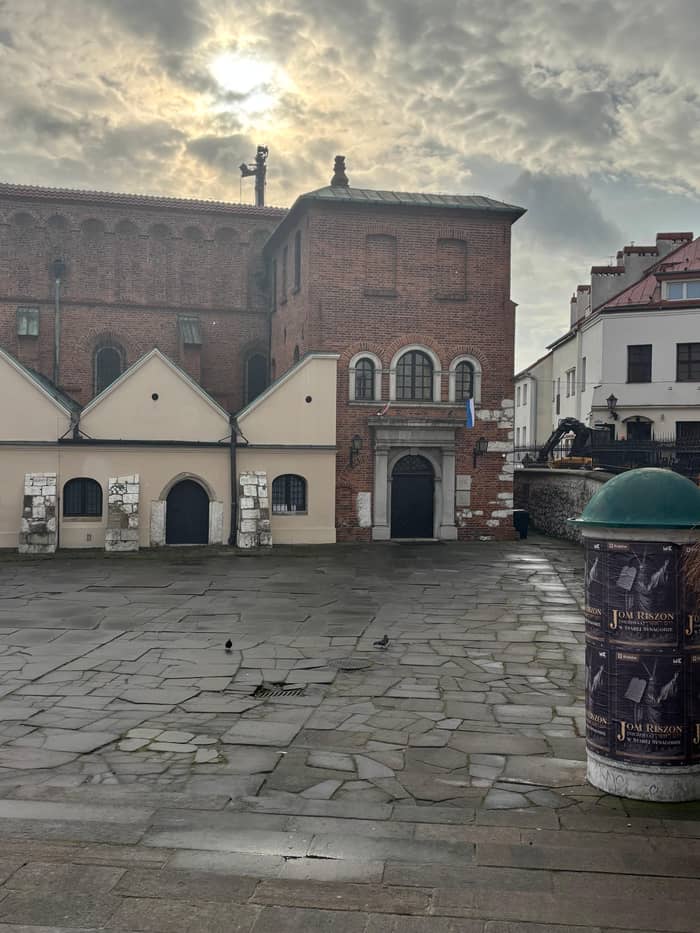
Our walk
Quarter and ghetto walk
Sold on this site
- Length2.5 hours
- StartOld Synagogue
- AccessWheelchair accessible
Guides
Language
Currency
See availabilityfrom €17 · cancel without payingChoose your stop
Kazimierz and former ghetto walk
★ 4.9 · 1,756 user reviews
Find out about 32 stops
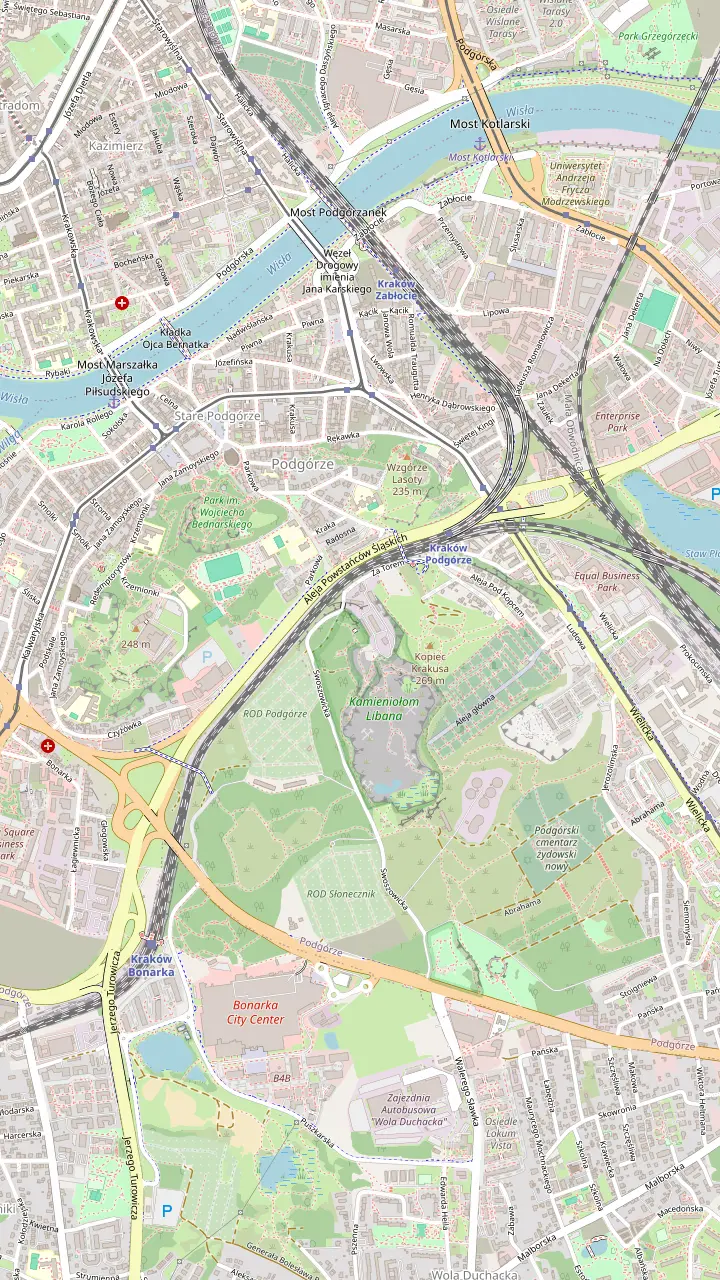
Select a route, then tap a marker or stop to see its note and open Google Maps.
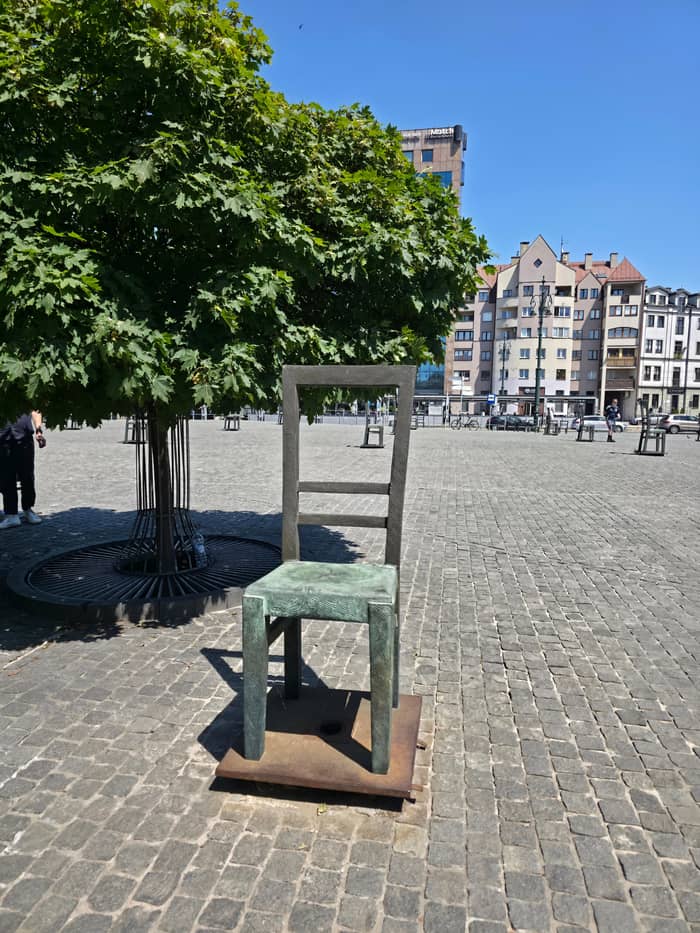
The former Zgody Square, with the memorial of empty chairs.
Google MapsTadeusz Pankiewicz's pharmacy in the ghetto, now a branch of the Museum of Krakow.
Google MapsOne of the surviving sections of the ghetto wall.
Google MapsA section of the ghetto wall behind the school at Limanowskiego 60/62.
Google MapsThe enamel factory at Lipowa 4 that Oskar Schindler took over in 1939, now a museum.
Google MapsLaid out in the 1780s, closed by St Joseph's church and its 80 m tower.
Google MapsSite of the camp set up late in 1942 on Jewish cemeteries; no camp buildings survive.
Google Maps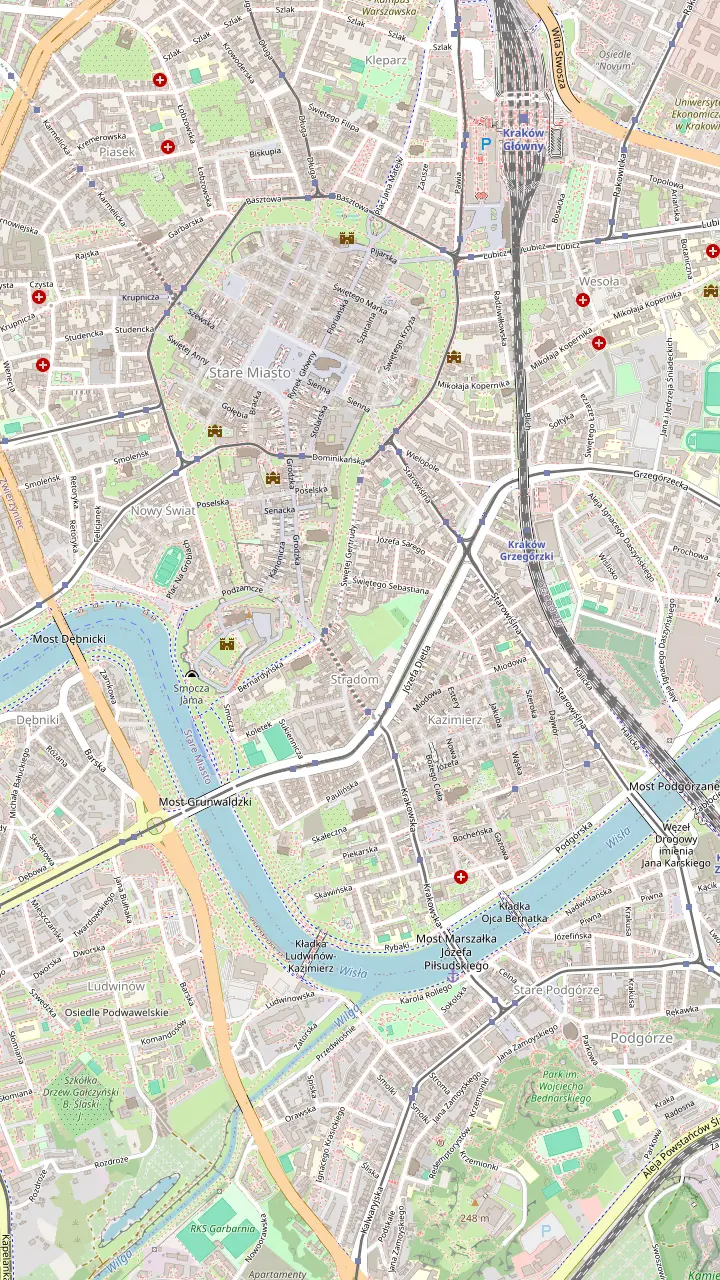
Laid out with the city charter of 1257; the usual start of a walk to Kazimierz.
Google MapsThe limestone hill above the Vistula, Krakow's ancient seat of power.
Google MapsRiverside paths for walking and cycling at the foot of Wawel.
Google MapsBuilt in 2010 between Kazimierz and Podgórze, lit from beneath at night.
Google Maps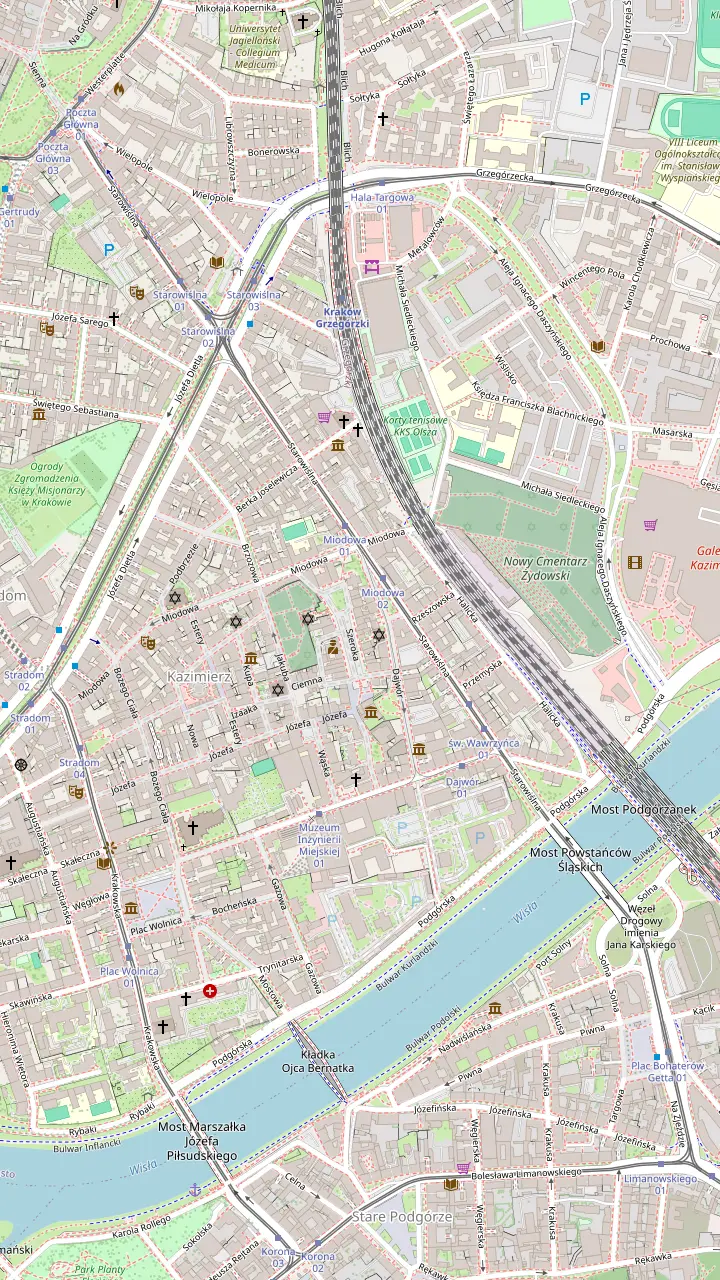
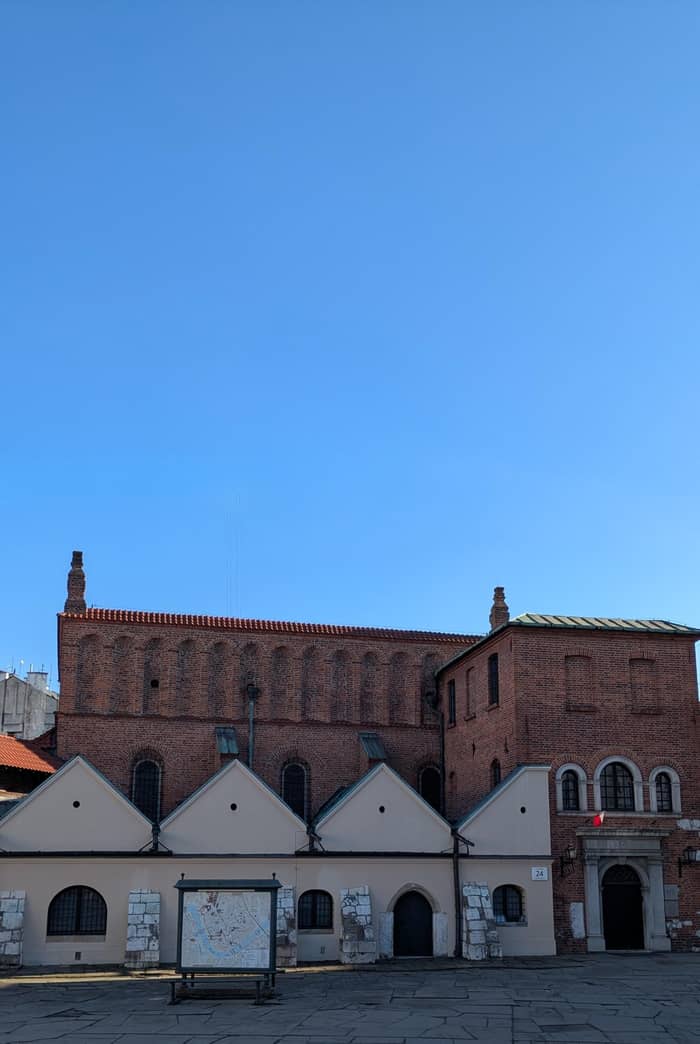
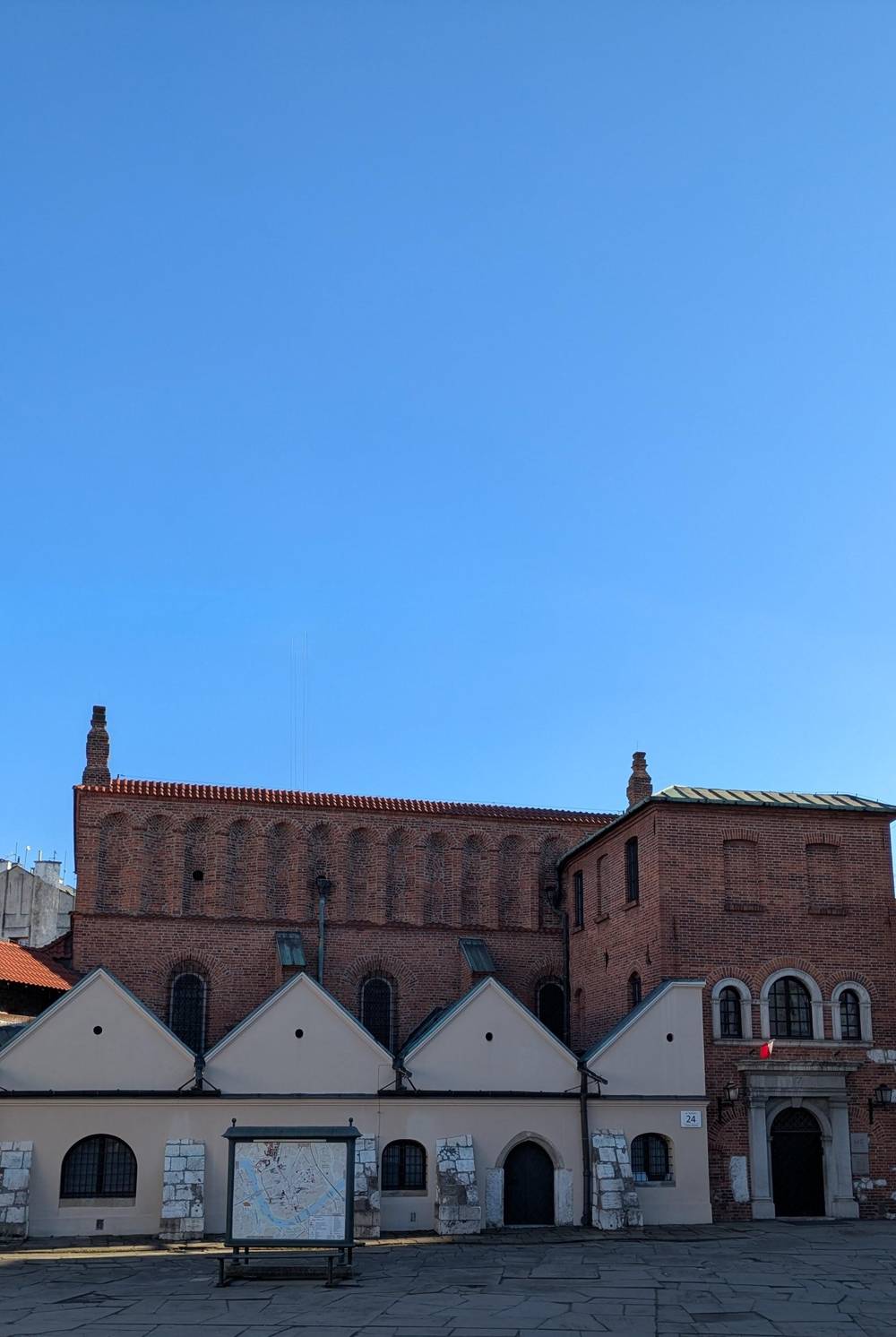
Szeroka 24: a Museum of Krakow branch on the history and culture of Krakow's Jews; free on Mondays.
Google MapsSzeroka 40: the community's main synagogue, with daily and holiday prayers.
Google MapsBurials from 1551; 711 gravestones and the Wall of Tears.
Google MapsFounded in 1620 by Wolf Popper; home of the Austeria bookstore since 2017.
Google MapsThe only synagogue in Poland with its prayer hall upstairs; closed, seen from outside.
Google MapsCompleted in 1644 for Izaak Jakubowicz; closed for conservation.
Google MapsBuilt in 1643 with goldsmiths' money; the community office, closed to visitors.
Google MapsReform synagogue of 1860-62 with 36 stained glass windows and festival concerts.
Google MapsMiodowa 55, opened in 1801: the only Jewish cemetery in Krakow still in use.
Google Maps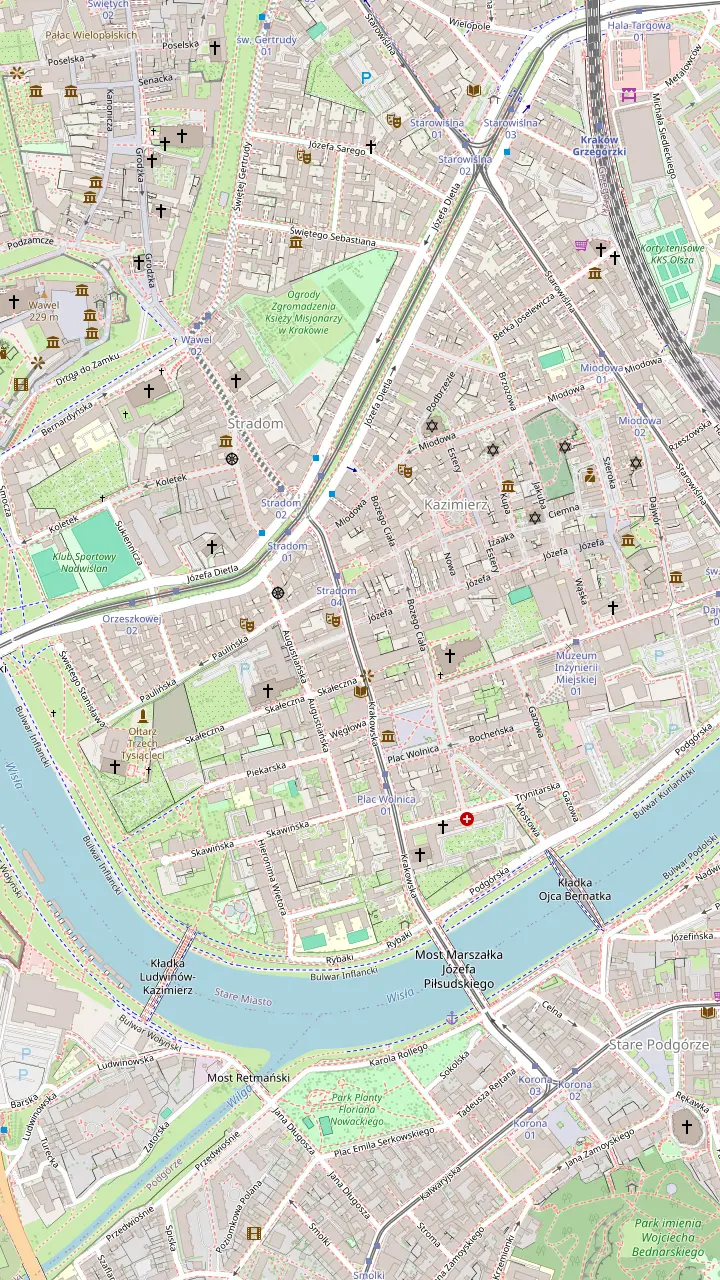
On Wolnica Square, the last sign of the town's autonomy, now the Museum of Ethnography.
Google MapsKazimierz's great parish church, with a boat-shaped pulpit and the city's largest organ.
Google MapsGothic church raised around 1343 for the Augustinian order.
Google MapsWhere Bishop Stanislaus died in 1079; its crypt holds great Poles, mostly artists.
Google MapsHeart of the Jewish town, with Austrian-era cobbles and the festival's closing concert in July.
Google MapsKrakowska 46, a branch of the Museum of Ethnography.
Google Maps
Flea market and snack windows known for the zapiekanka.
Google MapsRestaurant, cafe and bookshop in a former ritual bath on Szeroka; klezmer at 8 PM nightly.
Google MapsThe Jewish Culture Festival's cafe at Józefa 36: findjan coffee, mint tea and hummus.
Google MapsDajwór 18, open daily 10:00-18:00, with a cafe selling kosher snacks.
Google MapsJózefa Street: Polish plates, homemade liqueurs and live music on Wednesdays and Fridays.
Google MapsClub and cafe at Estery 5, on the corner of Plac Nowy.
Google MapsMap source: © OpenStreetMap contributors
The ghetto the German occupiers forced on Krakow's Jews in Podgorze, the places where its story is told today, and how to visit them with a guide or on your own, with care.
Editorial team, krakowjewishquartertour.click · Updated November 9, 2026 · 7 min of reading
Key facts
The ghetto of Krakow lay in Podgorze, on the right bank of the Vistula, opposite the old Jewish town of Kazimierz.1 A Krakow Jewish ghetto tour crosses the river to the places where its story can still be read: the square where people were gathered, the pharmacy that stayed open inside the walls, and the fragments of the wall itself.4,5,3 Most of the district looks like any other part of the city today, which is exactly why a guide is useful.
Our walk spends 2.5 hours on both banks, beginning outside the Old Synagogue. Ghetto Heroes Square and a Holocaust memorial are among the places its listing names. It is a Krakow Jewish Quarter and ghetto tour in the literal sense: it covers Jewish life before the war and the place where that life was destroyed.
Other formats keep to the ghetto alone. A short ghetto walk takes 1 hour from €15, while the Galicia Jewish Museum leads a 2-hour Former Ghetto walk of its own.6 If you want the factory museum in the same visit, a guided tour of Schindler's Factory and the ghetto lasts 3 hours from €50. Whichever you choose, the ghetto is not a place to rush. Leave a margin before your next plan, because many visitors want a quiet moment on the square once the guide has finished.
The places
| Place | Then | Today | Visit |
|---|---|---|---|
| Bohaterow Getta Square | Zgody Square, the gathering place4 | Memorial of chairs4 | Open space4 |
| Eagle Pharmacy | Pankiewicz's pharmacy inside the ghetto5 | Museum of Krakow branch16 | Wed to Sun, 9:00 - 17:0016 |
| Wall, Lwowska Street | Part of the 3-metre wall17 | Surviving fragment3 | Open space18 |
| Wall, Limanowskiego Street | Part of the ghetto boundary3 | Fragment behind the school3 | Open space3 |
| Plaszow camp site | Camp from late 194219 | KL Plaszow Memorial Site20 | 2 to 3 hours21 |
Opening hours and visiting times as the Museum of Krakow and the KL Plaszow Museum give them.16,21
Before the Second World War, more than 64,000 Jews lived in Krakow, a quarter of the city's population.10 For centuries Kazimierz had ranked among the great centres of Jewish learning and culture in Europe, and by the 1930s Jewish Krakow reached far beyond its old walls.11,12 Jewish families lived and worked across the city as merchants, craftsmen, doctors, teachers and artists, and their schools, newspapers and theatres were part of everyday Krakow, not a world apart from it.
The occupation changed that within months. Forced resettlements began at the start of the war, and only 16,000 Jews remained in the city.13 For those who stayed, the next step was the loss of their homes and their freedom of movement. Guides often pause here to explain how fast the occupation moved, from registration and armbands to confiscated businesses, so that the ghetto is understood as part of a deliberate sequence rather than a sudden event.
Standing in Kazimierz before you cross the river helps make sense of what followed. The synagogues, the prayer houses and the shop signs you see there belonged to the same families who were driven into Podgorze. That is why a good tour begins on Szeroka Street and only then walks over the Father Bernatek footbridge to the other bank.14
On 3 March 1941 the occupier ordered the Jews of Krakow into a "Jewish residential quarter" in Podgorze, which they had to enter by 20 March.1 The area held 320 tenement houses, previously home to around 3500 people, who were forced to leave.23 The pharmacy of Tadeusz Pankiewicz was the only business allowed to stay, and he became the only non-Jew living inside.5,24
A wall 3 metres high closed the district off, its arched top shaped to resemble Jewish tombstones.17 There were 4 gates, the main one where Limanowskiego Street enters the market square of Podgorze.24 Trams still ran along Lwowska and Limanowskiego streets, but with no stops inside the walls.25 Passengers on those trams could see into the ghetto as they passed through it, and the official ban on even looking through the windows says much about how openly the separation was carried out in the middle of a living city.
From October 1941 leaving the ghetto without permission was punishable by death, and so was helping anyone who escaped.7 Overcrowding and hunger followed. When you stand on these streets today, it helps to picture the windows bricked up and the gates guarded, and to remember that the ordinary tenements around you were the whole of the world for the people locked inside.
Choose your visit
Pick what you need from the visit and see the format that suits it.
If I want Jewish life before the war as well
The walk on this site
Life before the war, then the ghetto, on a 2.5-hour walk.
If I have an hour between other plans
The ghetto walk
A 1-hour walk of the former ghetto from €15.
If I want the factory museum too
Factory and ghetto
Skip-the-line entry and 3 hours with a guide.
If I want to see where the ghetto ended
Plaszow
A 2-hour guided walk of the former camp site.
If I prefer a museum-led guide
Galicia Jewish Museum
The museum's own Former Ghetto walk lasts 2 hours.6
With a guide
Our walk
Sold on this site
With museum
With the museum
Camp site
The camp on the hill
In June and October 1942 the occupiers carried out deportations of great brutality, and many people were killed in the streets during the round-ups.88 The painter Abraham Neuman and the poet and folk singer Mordecai Gebirtig were among those murdered on 4 June 1942, the day remembered as "bloody Thursday".8
Late in 1942 the shrinking ghetto was divided by barbed wire, with part A for those able to work and part B for children, the elderly and the sick.9 The final liquidation came on 13 and 14 March 1943, when around 6000 people from part A were moved to the camp at Plaszow.2 Their children under 14 had to stay behind in the orphanage.89
In the liquidation around 1000 people were shot dead on the spot, among them the elderly, hospital patients and their doctors, and children with the mothers who would not leave them.90 Those who survived the day were sent to KL Auschwitz.90 A guide will usually tell this part of the story on the square itself, and it is worth giving it your full attention.
Dates
3 March 1941
Jews ordered into a quarter in Podgorze.1
October 1941
Leaving without permission punishable by death.7
4 June 1942
Mordecai Gebirtig and Abraham Neuman among the murdered.8
Late 1942
Barbed wire divides part A from part B.9
13 March 1943
Around 6000 people moved to Plaszow.2
The former Zgody Square, where people were gathered for deportation, is now Bohaterow Getta Square, whose name honours the heroes of the ghetto.4 Its memorial is a field of oversized chairs, recalling the furniture and belongings left scattered across the empty ghetto.4 Every year a March of Memory sets off from this square to the former Plaszow camp on the anniversary of the liquidation.22
On the corner of the square, at number 18, stands the Eagle Pharmacy, also known as the Pharmacy Under the Eagle.5 Open day and night, it served as a secret meeting place for the underground and a contact point for food and medicine.91 Tadeusz Pankiewicz later recorded what he witnessed in his book Pharmacy in the Krakow Ghetto.92
Today the Museum of Krakow runs the pharmacy as a branch, open Wednesday to Sunday from 9:00 to 17:00.16 A normal ticket costs PLN 22, and entry is free on Wednesday.93,86 Inside, the pharmacy interior has been recreated, and its drawers hold documents and photographs that tell the story of the ghetto. A ticket to Schindler's Factory also admits you to the pharmacy within 7 days, so the museums are easily combined in a single afternoon.94
Video
The History Underground on YouTube · Tap play to load the video; not before.
Every year the March of Memory is organised on the anniversary of the liquidation of the ghetto.
Visiting with care
Very little of the ghetto itself survives. The only physical remnants are 2 sections of the wall, on Lwowska Street and behind the school at number 60/62 on Limanowskiego Street.3 The Polish Tourism Organisation points visitors to the fragment at 29 Lwowska Street, near the square and the factory museum.18
Beyond the wall, the ghetto survives as ordinary streets of tenements. Its main gate, inscribed Jüdischer Wohnbezirk, stood where Limanowskiego Street enters the Main Market of Podgorze.24 Little on the buildings themselves tells you where the boundary ran, which is why a guide is the easiest way to read these streets.
If you come on your own, start at the wall on Lwowska Street, then walk to Bohaterow Getta Square and the pharmacy, and finish at Schindler's Factory on Lipowa Street.18,95 The map on this page shows those places, and the page on the self-guided walk links them to Kazimierz across the river. A Krakow Jewish ghetto walking tour with a guide covers the same ground in a fixed order, which is the easier choice on a first visit.
South of the ghetto lies the site of the Plaszow camp, set up late in 1942 on Jewish cemeteries, its main road paved with tombstones.19 At its height it held around 35,000 prisoners under the commandant Amon Goeth.96 An estimated 5000-6000 victims of mass executions were buried there, and between 50,000 and 150,000 people are thought to have passed through the camp.97,98
No camp buildings stand today; the villa of Amon Goeth at 22 Heltmana Street and the Grey House at 3 Jerozolimska Street remain.99 The site is now the KL Plaszow Memorial Site, run by the Museum of Krakow since 1 January 2021, and it can be visited on your own, with a hired guide or at museum events.20,100 Boards at the 7 main entrances set out the rules of the grounds.87
Plan on 2 to 3 hours there, the museum advises.21 A guided walk of the camp site lasts 2 hours and starts at the Pharmacy Under the Eagle. Treat it as a cemetery, which in large part it is: stay on the marked paths, speak quietly, and leave the monuments as you found them. The 7-metre Monument to Nazi Victims stands on a low rise by Kamienskiego Street, and a handful of low obelisks also commemorate the victims.101
FAQ
In March 1941 the German authorities forced the city's Jews into Podgorze, on the far side of the Vistula from Kazimierz.1
Look for them on Lwowska Street and at 60/62 Limanowskiego Street, behind a school.3
Sculptures of chairs recall the empty ghetto and its abandoned belongings.4
The former ghetto is in its title, and Ghetto Heroes Square is on its list of places.
The memorial site can be visited individually, with a hired guide or at museum events.100
The Galicia Jewish Museum combines Podgorze and Plaszow into a 4 hour tour.15
Sources
Planning a walk through Kazimierz? Ask a real person here.