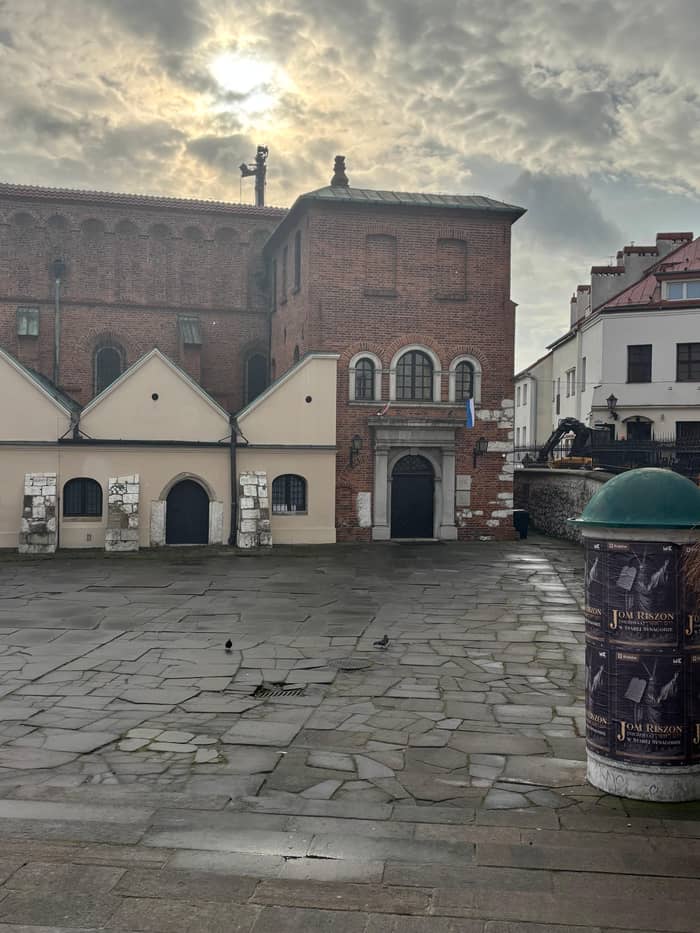
Our pick
Jewish Quarter and ghetto
Kazimierz and Podgórze
- Length2.5 hours
- MeetsSzeroka 24
- GuideEnglish
Guides
Language
Currency
See availabilityfrom €17 · cancel without payingChoose your stop
Answer in brief
Kazimierz Krakow history runs from a royal town founded by Casimir the Great, through centuries as the Jewish town around Szeroka Street and the years of Austrian rule, to wartime destruction and a revival after the end of communism.
Key dates
Find out about 32 stops
Select a route, then tap a marker or stop to see its note and open Google Maps.
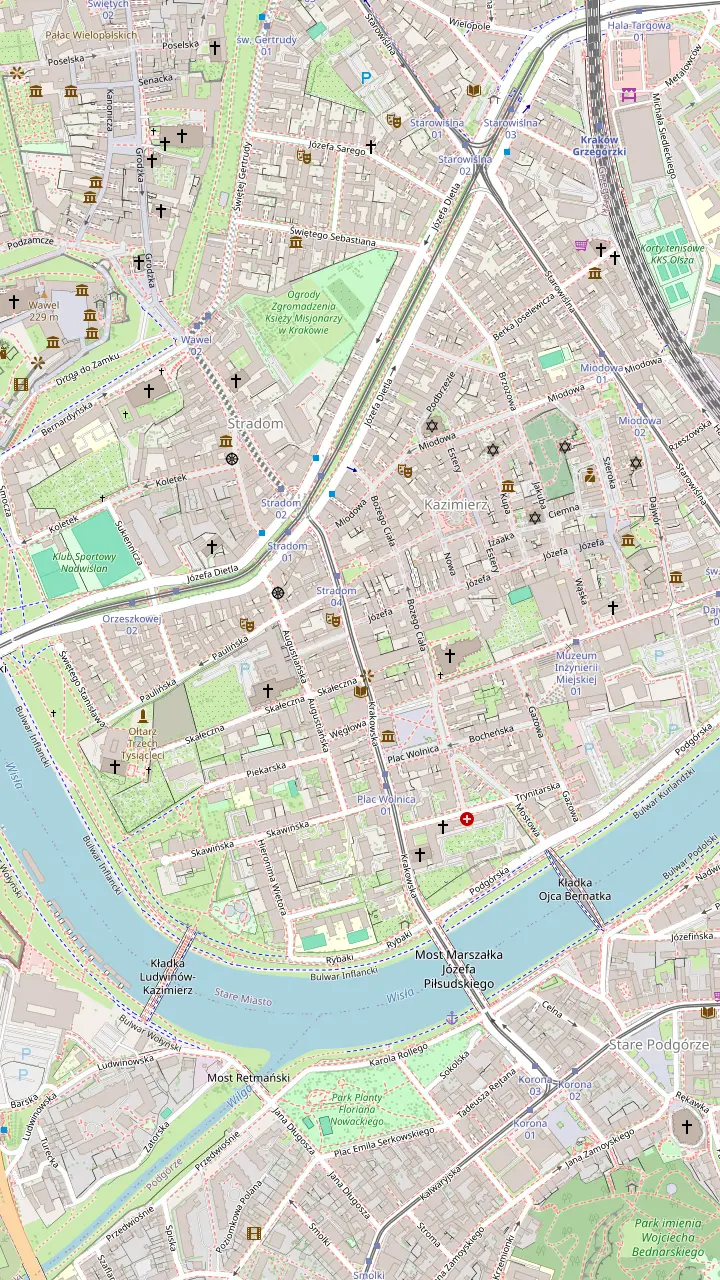
On Wolnica Square, the last sign of the town's autonomy, now the Museum of Ethnography.
Google MapsKazimierz's great parish church, with a boat-shaped pulpit and the city's largest organ.
Google MapsGothic church raised around 1343 for the Augustinian order.
Google MapsWhere Bishop Stanislaus died in 1079; its crypt holds great Poles, mostly artists.
Google MapsHeart of the Jewish town, with Austrian-era cobbles and the festival's closing concert in July.
Google MapsKrakowska 46, a branch of the Museum of Ethnography.
Google Maps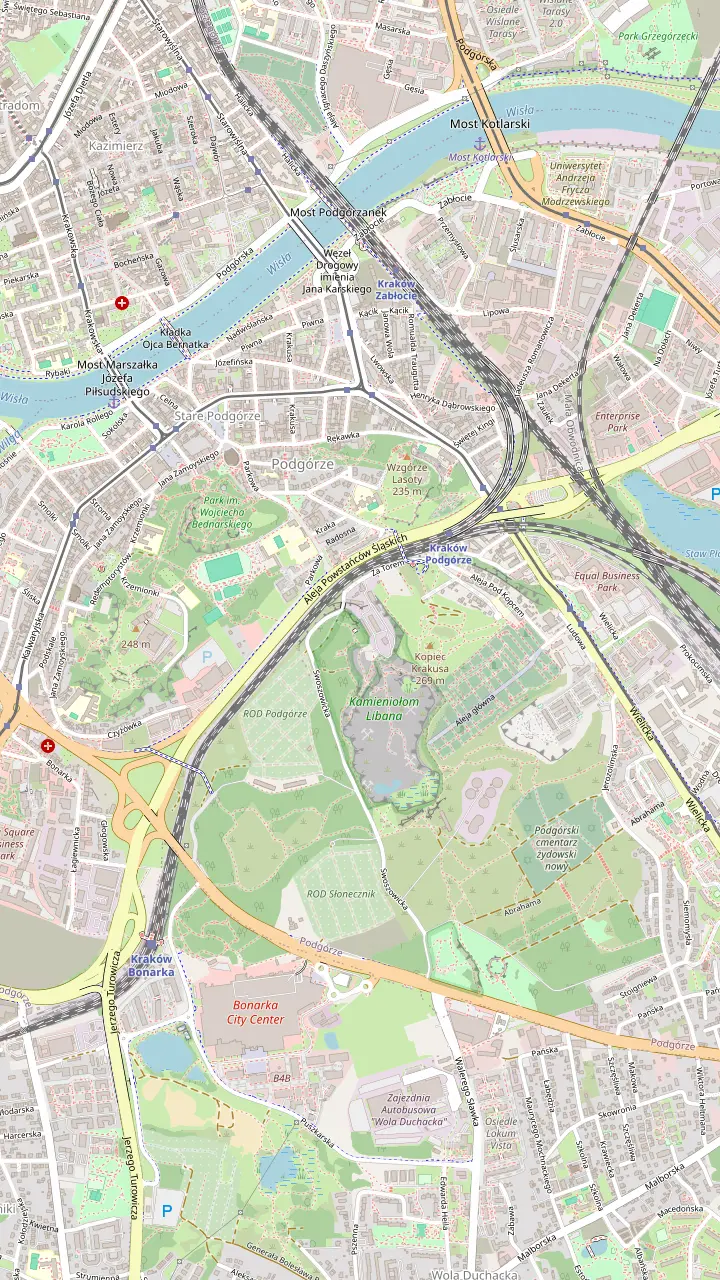
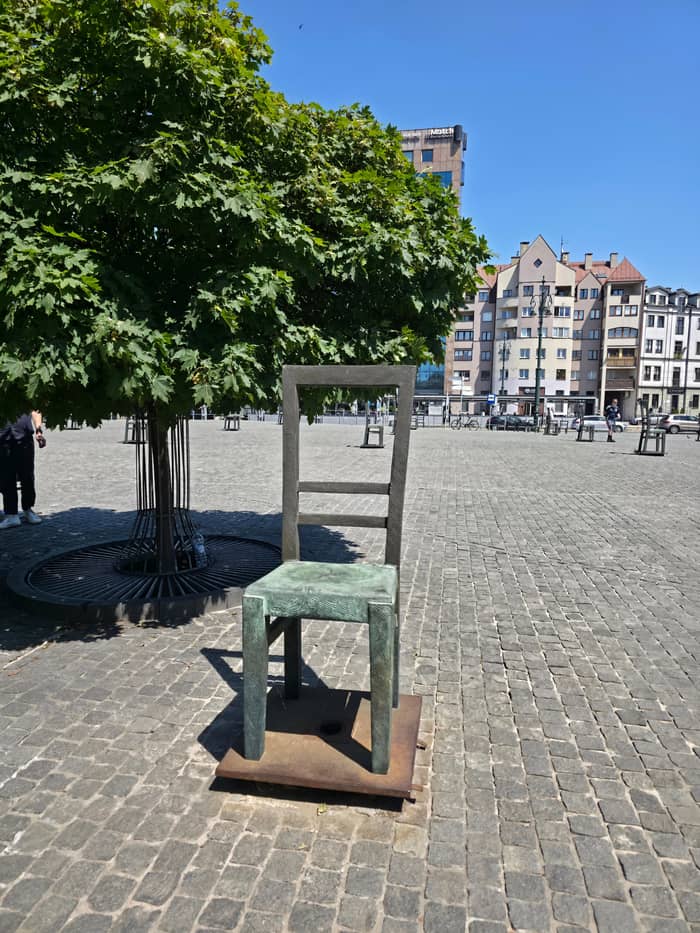
The former Zgody Square, with the memorial of empty chairs.
Google MapsTadeusz Pankiewicz's pharmacy in the ghetto, now a branch of the Museum of Krakow.
Google MapsOne of the surviving sections of the ghetto wall.
Google MapsA section of the ghetto wall behind the school at Limanowskiego 60/62.
Google MapsThe enamel factory at Lipowa 4 that Oskar Schindler took over in 1939, now a museum.
Google MapsLaid out in the 1780s, closed by St Joseph's church and its 80 m tower.
Google MapsSite of the camp set up late in 1942 on Jewish cemeteries; no camp buildings survive.
Google Maps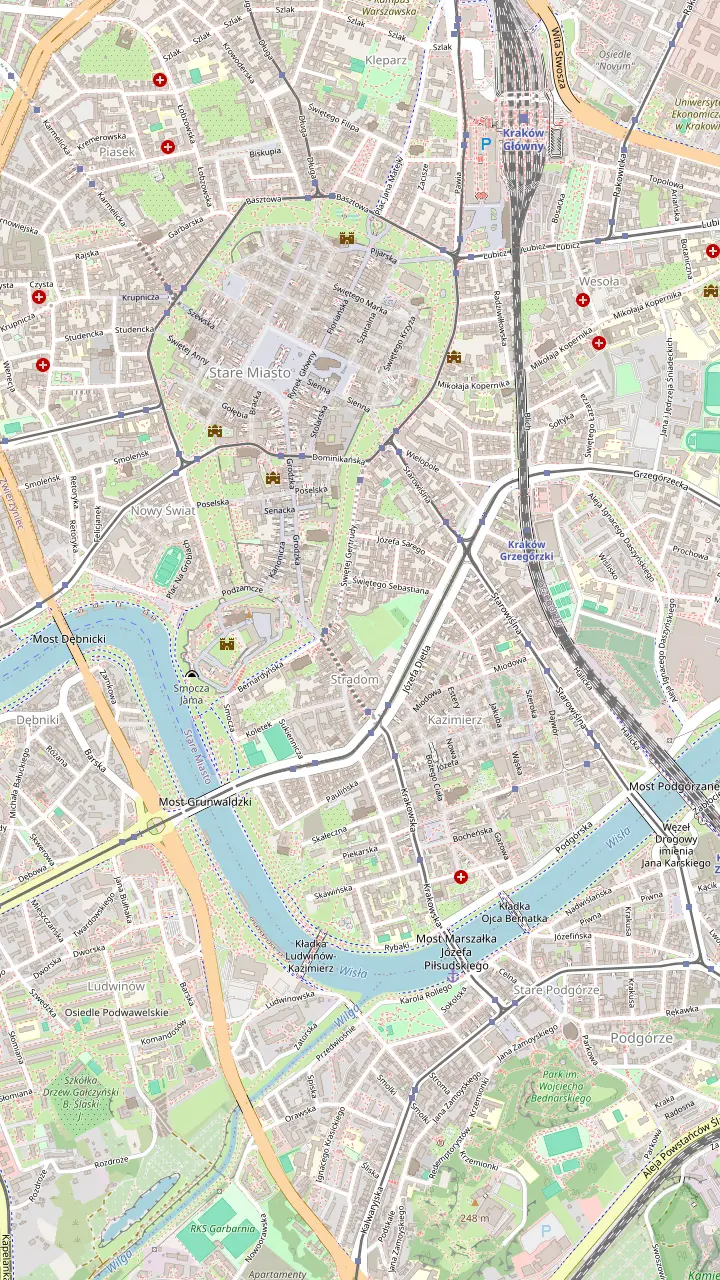
Laid out with the city charter of 1257; the usual start of a walk to Kazimierz.
Google MapsThe limestone hill above the Vistula, Krakow's ancient seat of power.
Google MapsRiverside paths for walking and cycling at the foot of Wawel.
Google MapsBuilt in 2010 between Kazimierz and Podgórze, lit from beneath at night.
Google Maps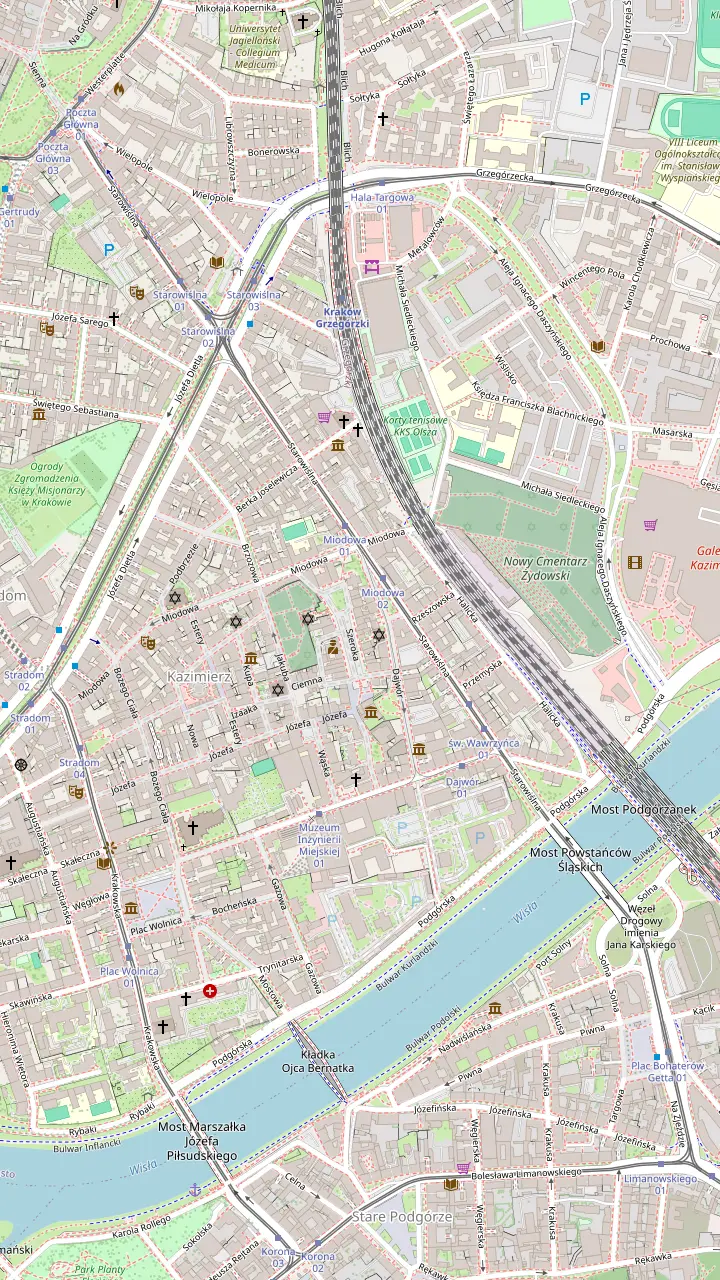
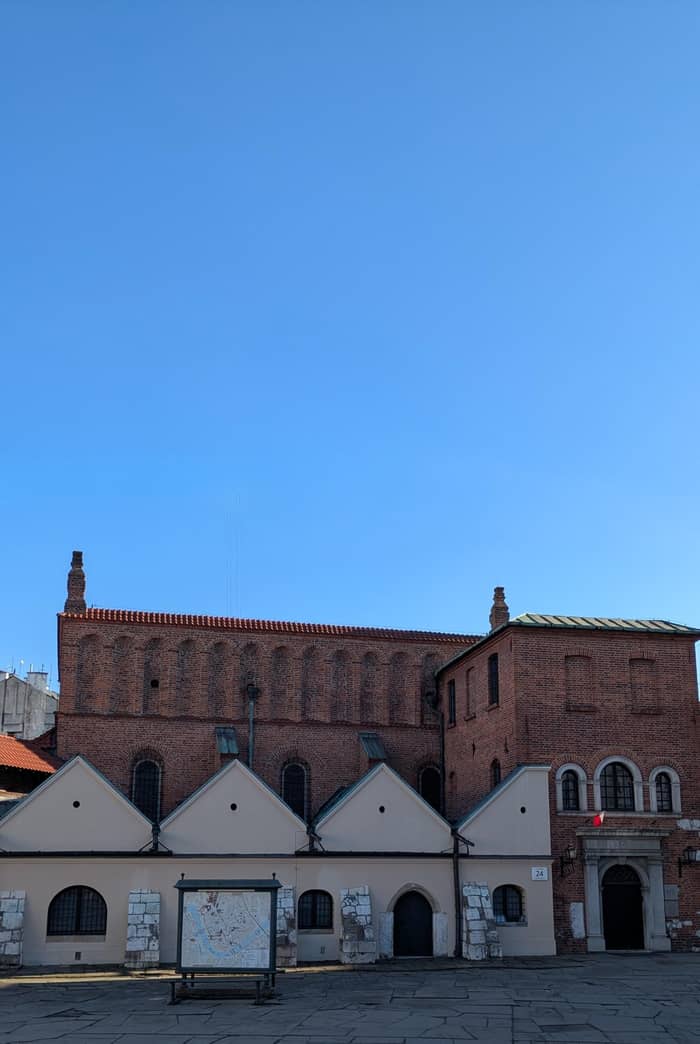
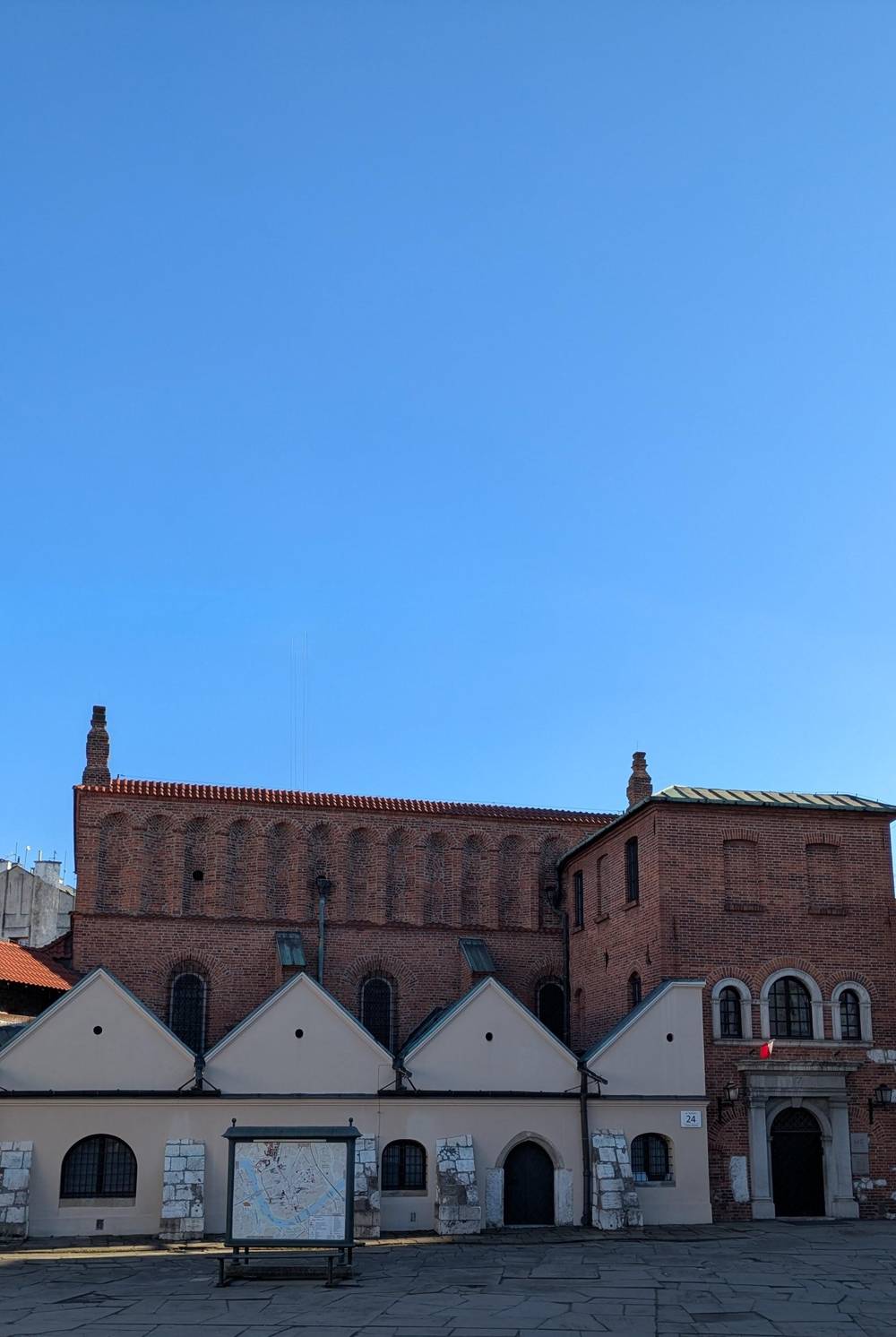
Szeroka 24: a Museum of Krakow branch on the history and culture of Krakow's Jews; free on Mondays.
Google MapsSzeroka 40: the community's main synagogue, with daily and holiday prayers.
Google MapsBurials from 1551; 711 gravestones and the Wall of Tears.
Google MapsFounded in 1620 by Wolf Popper; home of the Austeria bookstore since 2017.
Google MapsThe only synagogue in Poland with its prayer hall upstairs; closed, seen from outside.
Google MapsCompleted in 1644 for Izaak Jakubowicz; closed for conservation.
Google MapsBuilt in 1643 with goldsmiths' money; the community office, closed to visitors.
Google MapsReform synagogue of 1860-62 with 36 stained glass windows and festival concerts.
Google MapsMiodowa 55, opened in 1801: the only Jewish cemetery in Krakow still in use.
Google Maps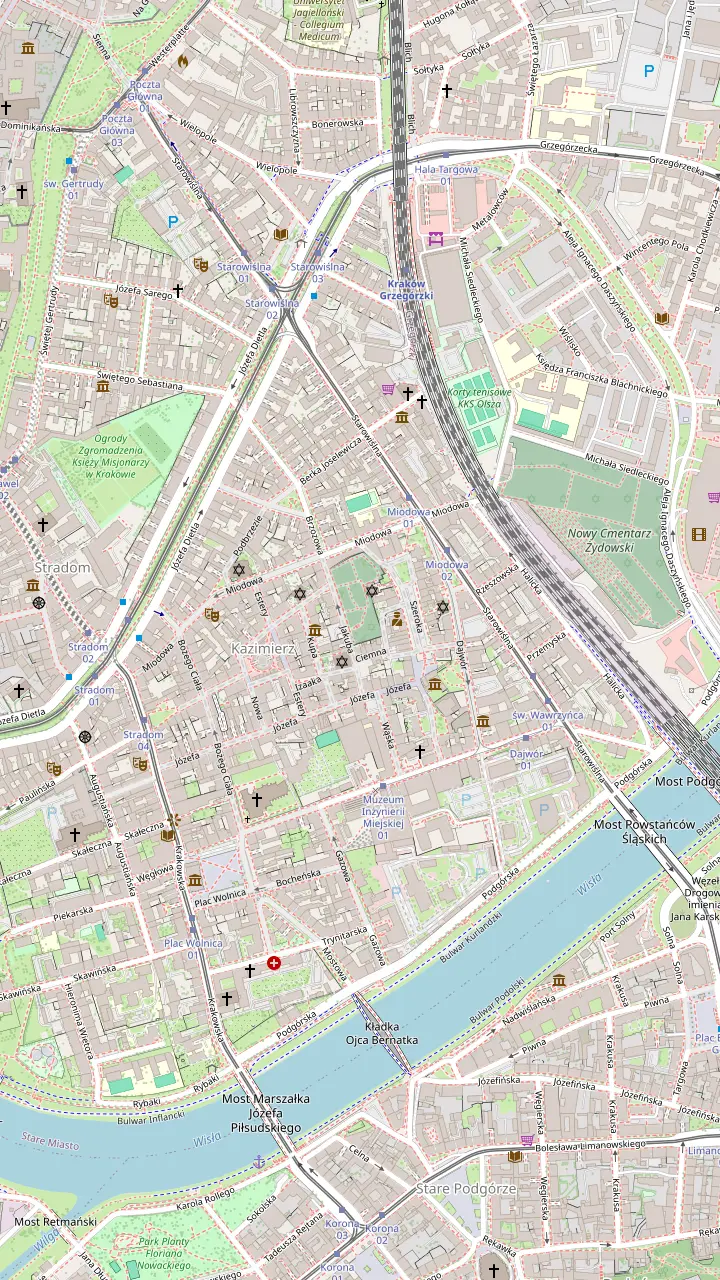
Flea market and snack windows known for the zapiekanka.
Google MapsRestaurant, cafe and bookshop in a former ritual bath on Szeroka; klezmer at 8 PM nightly.
Google MapsThe Jewish Culture Festival's cafe at Józefa 36: findjan coffee, mint tea and hummus.
Google MapsDajwór 18, open daily 10:00-18:00, with a cafe selling kosher snacks.
Google MapsJózefa Street: Polish plates, homemade liqueurs and live music on Wednesdays and Fridays.
Google MapsClub and cafe at Estery 5, on the corner of Plac Nowy.
Google MapsMap source: © OpenStreetMap contributors
Kazimierz Krakow history in one walk: a royal town that rivalled its neighbour, a Jewish town that shaped Europe, Austrian rule, the war, and a revival that is still going on.
Editorial team, krakowjewishquartertour.click · Updated November 9, 2026 · 8 min of reading
Key facts
Kazimierz began as a rival, not a suburb. King Casimir the Great founded it in the 14th century to guard the southern approaches to his capital, and it took his name.1 The city guide gives 1335 for its charter.2 Its main street, Krakowska, ran on as the trade road to Hungary, and in the Middle Ages the town counted as the second most important in Poland.7,8 Walk Krakowska Street today and you are on that old road south.
Like Krakow, it laid out a large market square soon after its charter, 195 m on each side, with a town hall, scales and stalls.9 Butchers outside the guild could sell there once a week, a right of free trade that gave the square its name, Wolnica.10 The salt road from Wieliczka and Bochnia passed through it too.11 Today's Wolnica Square is a fragment of that space, and the town hall on it is the last proof of the town's independence.12
The great churches of Christian Kazimierz date from this time. Corpus Christi was entrusted in 1405 to the Canons Regular of the Lateran, who still serve it.13 St Catherine's was raised around 1343 for the Augustinians, as a royal act of penance.14 If you want to understand Kazimierz history in Krakow, start here: the Jewish town that became famous grew up inside a Christian city with its own council, churches and market.
Eras at a glance
| Period | What happened | Where to see it |
|---|---|---|
| Royal town | Charter, market, churches | Wolnica, Corpus Christi |
| Jewish town | Settlement after 1495 | Szeroka Street |
| Golden age | Scholars and synagogues | Remuh, Isaac, Kupa |
| Austrian rule | Merger, walls torn down | Szeroka cobbles, Tempel |
| War | Ghetto in Podgórze | Ghetto Heroes Square |
| Revival | Festival, museums, JCC | Galicia Jewish Museum |
Periods and places as the Krakow city tourist guide, the Jewish Religious Community and the Galicia Jewish Museum describe them.2,3,4,27,28,29
The turning point came with King John Albert's decree of 1495, which in effect made Krakow's Jews leave the city for Kazimierz.3 An autonomous, walled Jewish town took shape inside Kazimierz, with Szeroka Street at its centre.17 Around it rose synagogues, schools and academies.18 The Jewish town had its own leaders, courts and charities, while the Christian town around it kept its council, churches and market. The two lived side by side, sometimes in cooperation and sometimes in dispute, for centuries.
A plaque on the Kazimierz town hall, put up in 1996, recalls how Jewish refugees persecuted elsewhere in Europe were welcomed in Poland in Casimir's reign.19 For centuries this Jewish town ranked among Europe's leading centres of Jewish learning and faith.18 Its houses of prayer still mark the map: the community dates the Old Synagogue to 1407, the High to around 1556 and the Remuh to around 1558.20,21,22
Daily life left its own traces. The ritual bath at Szeroka 6 was fed by a spring, and a record of 1567 tells of women drowned when its floor gave way.23 Szeroka itself is more an elongated square than a street, and the city guide notes that it once held four synagogues, something unheard of elsewhere in Europe.24,25 The walls that closed the Jewish town are mostly gone, though a stretch survives by the Kupa Synagogue on Warszauera Street.26
Key dates
1335
Kazimierz is chartered as a town beside Krakow.2
1495
Krakow's Jews settle in Kazimierz after a royal decree.3
1655-57
War ends the town's golden age.15
1800
Kazimierz becomes a district under Austrian rule.4
1941-43
Krakow's Jews are confined in Podgórze.16
1989
The district's rebirth starts after political change.6
The 16th and 17th centuries were the Jewish town's great age. Moses Isserles, the Remuh, lived and taught here in the 16th century, and Jews still come on pilgrimage to his grave.33 In the next century the Kabbalist Natan Spira studied at 22 Szeroka Street; the city guide repeats the story that his candle burnt out in 1633 and he died with it.34 Scholars, rabbis and students came from far beyond Poland to study in the town's academies, and their books travelled the other way.
Money and faith built the synagogues of this age. Wolf Popper, among the richest men in Kazimierz, founded his synagogue in 1620.35 Goldsmiths paid for the Kupa in 1643, and the banker Izaak Jakubowicz completed the Isaac in 1644.36,37 His royal permit was contested by the parish priest of Corpus Christi, a small sign of the tension between the two communities that shared the town.38 Izaak won his case, and his synagogue still stands.
Then came war. The Swedish Deluge of 1655-57 ended the splendour of Kazimierz.15 King Charles Gustav of Sweden made his headquarters at Corpus Christi in 1655 and directed the siege of Krakow from there.39 The Isaac Synagogue was stripped of its furnishings in the same war.40 Both the Jewish and the Christian town emerged poorer, and the age of its splendour was over. Fires, debts and later wars added to the damage over the following century.
Follow your interest
Pick the chapter of the story you most want to stand in.
If The medieval royal town
Wolnica Square
Its town hall is the last proof of the town's autonomy.12
If The Jewish golden age
Szeroka Street
It was the centre of the Jewish town from the 15th century.17
If The war years
Across the river to Podgórze
The ghetto stood there in 1941-43.16
If The story told by experts
The Old Synagogue museum
It shows the history and culture of Krakow's Jews.30
If Life today
The Jewish Community Centre
It had over 1,200 members in 2025.31
History on foot
Our pick
Kazimierz and Podgórze
Shorter walk
Synagogues and old houses
On two wheels
Old Town, Jewish Quarter, ghetto
Was Krakow part of Galicia? Galicia was the name given to the lands Austria took from Poland in the partition of 1772.95 After that first partition the Vistula became a border: Krakow on the left bank stayed Polish while Podgórze across the river became Austrian, and in 1784 the emperor Joseph II gave Podgórze city rights.96,97 Austrian troops then captured Krakow itself in 1796.98 For the next few years Kazimierz, Krakow and Podgórze lay on the same side of an imperial border.
Under Austria the old order of Kazimierz ended. In 1800 it lost its independence and became a district of Krakow.4 The same year the Austrian authorities closed the old Remuh cemetery, and in 1822 the walls of the Jewish district were demolished, allowing Jews to settle anywhere in Kazimierz.99,100 The cobbles still visible on Szeroka were laid in the days of Austrian rule.27 Look down as you cross the square: they are among the few of their kind left in the city.
In the 19th century Kazimierz became a centre of Orthodox Judaism and a place of pilgrimage for Jews from across the old Polish-Lithuanian lands.101 Modern Jewish life grew alongside it: the reform Tempel went up in 1860-62, with sermons in Polish and German.54,102 Galicia gained partial autonomy in 1867.103 Podgórze was joined to Krakow in 1915.104 The Galicia of those years now lies in south-eastern Poland and western Ukraine.105
Cost of a history walk
Choose a guided walk or ride and say how many are coming.
Compare 3 side by side
Choose a guided walk or ride and say how many are coming.
≈
View≈
View≈
ViewGetYourGuide's starting prices, converted at the ECB reference rate; exact pricing appears when you book.
By the 1930s Jews made up about a quarter of Krakow's population, according to the city guide.106 Its page on the ghetto gives the figure as over 64,000 people before the Second World War, 25% of the city.5 Kazimierz was their historic centre. Prayer houses, schools, workshops and shops filled the streets you walk today, and the community's own map of pre-war houses of prayer shows how close together they stood.
Religious life was varied. The Tempel's preacher Ozjasz Thon, who sat in the Polish parliament in the interwar years, drew large crowds to his sermons.107,108 The community put a small synagogue museum above the Old Synagogue porch in 1923, an early sign of interest in its own heritage.109 The Miodowa cemetery filled up in these years, and from 1932 burials moved to new grounds on Abrahama and Jerozolimska Streets.110
It helps to picture this world before you visit, because so little of it is visible now. When you sit at a table on Szeroka or Józefa Street, you are in the middle of what was a dense, working Jewish neighbourhood, not a stage set. Read the names on the old shop signs and gateways, and imagine the market voices, the prayer times and the Friday rush before Shabbat that once set the rhythm of these streets.
Video
Frieda Vizel on YouTube · Tap play to load the video; not before.
Once independent, the city situated south of Wawel was the hub of Jewish life in Kraków for centuries
Make the history visible
The Second World War brought the destruction of Krakow's Jewish community.111 In the spring of 1941 the German occupiers forced the Jews who remained into a closed ghetto across the river in Podgórze, which existed until 1943.112,16 Its final liquidation took place on 13 and 14 March 1943.113 This site's page on the ghetto in Podgórze tells that history in full. Kazimierz and Podgórze are linked by a footbridge today, and the short walk between them is the walk many families were forced to make.
Kazimierz itself was emptied and its buildings put to other uses. The Old Synagogue was deliberately wrecked and turned into storage, and its library was stolen or destroyed.114 The Tempel became storehouses and stables.115 The Isaac housed a theatre workshop where Tadeusz Kantor painted sets.116 The Remuh cemetery was turned into a landfill.117 What could be carried off was taken, and what could not be carried off was left to decay.
The violence did not end with the war. In August 1945 the Kupa Synagogue was the scene of the first post-war pogrom in Poland.118 Every year the March of Memory follows the route from the ghetto square to the site of the Płaszów camp, on the anniversary of the ghetto's liquidation.119 Visit these places with that weight in mind, and with the respect they ask of you. Quiet, modest dress and an unhurried pace matter more here than any photograph.
After the war the history of the Jewish Quarter in Krakow was one of silence and slow repair. The Old Synagogue was rebuilt between 1956 and 1959 and handed to the city museum for an exhibition on Krakow's Jews.120,30 Clearing the Remuh cemetery began in 1956, when around 700 buried tombstones came to light.121 In 1978 UNESCO listed the historic centre of Krakow, including Kazimierz and Stradom.122
The real change came late in the communist period. The Jewish Culture Festival was founded in 1988.123 After the political changes of 1989 the district's rebirth began, and the Isaac Synagogue was returned to the Jewish community the same year.6,124 In Schindler's List, Szeroka Street stood in for a square in the wartime ghetto.125 Since then the district has filled with cafes, galleries and small hotels, and its history has become part of what visitors come to see.126
New institutions followed. The Galicia Jewish Museum opened in April 2004, the Jewish Community Centre behind the Tempel was built in 2006-08, and in April 2016 the restored Remuh became the community's main house of prayer.29,127,128 The community centre counted more than 1,200 members from 24 countries in 2025.31 Remembrance, the city guide says, is kept alive by cultural institutions and by the resurgent Jewish community.129
FAQ
It lost its independence and became a district of Krakow that year.4
An autonomous walled Jewish town was created here late in the 15th century.17
They made up 25% of the city's population, the city guide says.5
The ghetto stood across the river in Podgórze in 1941-43.16
The district's rebirth began after Poland's political changes that year.6
Sources
Also worth reading
Planning a walk through Kazimierz? Ask a real person here.