Our pick
Jewish Quarter and ghetto
Names the Jewish cemetery
- Length2.5 hours
- StartOld Synagogue
- GuideEnglish
Guides
Language
Currency
See availabilityfrom €17 · cancel without payingYour own checklist
Answer in brief
The old Jewish cemetery in Kazimierz, Krakow lies behind the Remuh Synagogue on Szeroka Street, with Renaissance gravestones, the grave of Rabbi Moses Isserles and the Wall of Tears; the cemetery on Miodowa Street is still in use.
Plan around
Preparation · 8 items
Tick items as you finish them. We save your progress on this device.
0 / 8 ready
You are ready. Only the date and the number of walkers are left to choose.
Secure your spotBehind the Remuh lies the old Jewish cemetery in Kazimierz, Krakow, with Renaissance stones and a wall of broken ones; a short walk east, the Miodowa cemetery is still in use.
Editorial team, krakowjewishquartertour.click · Updated November 9, 2026 · 8 min of reading
Key facts
Kazimierz has two Jewish burial grounds within a short walk of each other, and they tell different stories. The first lies behind the Remuh on Szeroka, a walled garden of old stones that the Jewish community calls one of the oldest Jewish cemeteries preserved in Europe.9 The second sits further east on Miodowa Street and is the only Jewish cemetery in Krakow where burials still take place.6
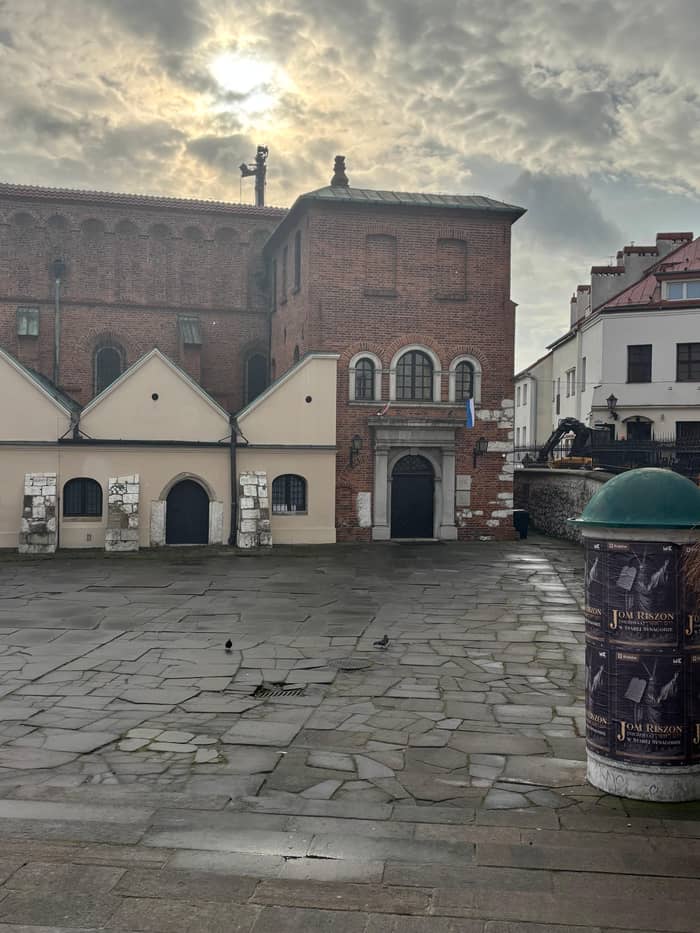
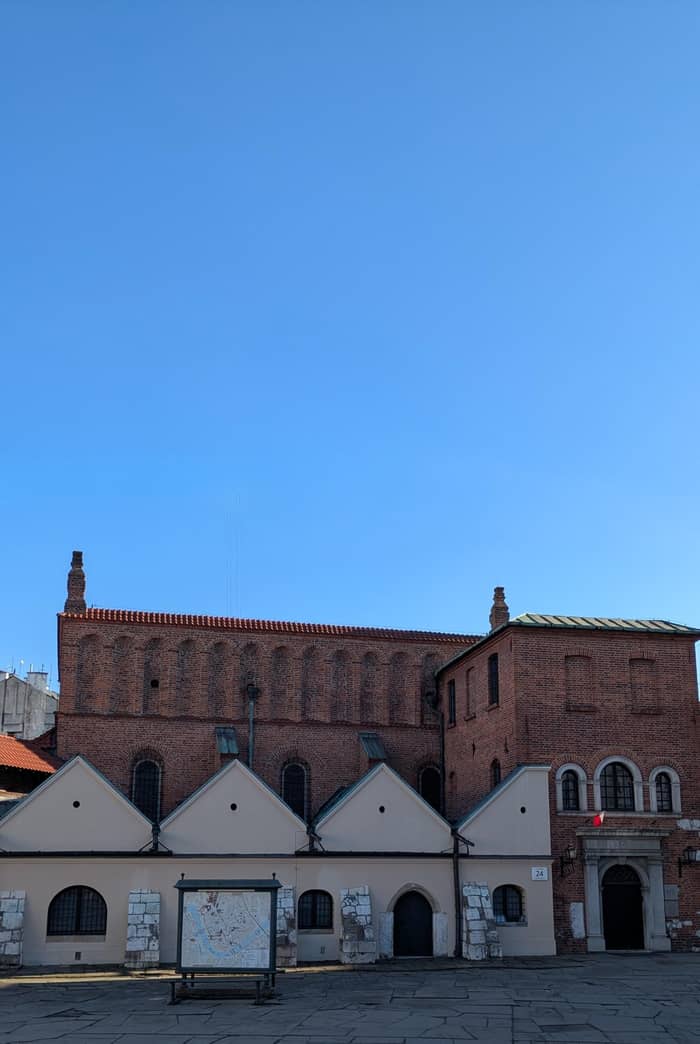
This guide covers both. If you came looking for the old Jewish cemetery in Kazimierz, Krakow, start with the Remuh: the entry for the synagogue and the cemetery is the same gate at Szeroka 40.10 The Miodowa cemetery takes longer to reach and longer to see, and it feels far less visited. Together they span the city's Jewish life from the rabbis of the 16th century to the musicians, painters and civic leaders of the modern city.
Both are religious places first. They are run by the Jewish Religious Community of Krakow, they shut for the Sabbath and Jewish festivals, and the rules that apply in its synagogues apply here too.7,11 Read the section on conduct before you go, and plan the visit for a weekday or Sunday morning, when you can take your time among the graves. Wear comfortable shoes: the ground is uneven and some paths are narrow between the stones.
Side by side
| Remuh cemetery | Miodowa cemetery | |
|---|---|---|
| Address | Szeroka 40 | Miodowa 55 |
| First burials | 1551 | 1801 |
| Stones | 711 | About 10,000 |
| Open | Sun to Fri, 9:00 to 16:00 | Sun to Fri, 9:30 to 16:30 |
| Closed | Saturdays, holidays | Saturdays, holidays |
| Burials today | No | Yes |
Hours as the Jewish Religious Community of Krakow lists them; other community pages give seasonal hours with last entry at 17:30.1,5,3,20,7,8,21,6
The city guide dates the first burials behind the Remuh to 1551, a few years before the synagogue itself.1 The community's figures put the oldest preserved grave at 1552 and the latest at 1850.15 In 1800, after Kazimierz was merged into Krakow, the Austrian authorities closed it along with all the church cemeteries of Krakow.16 The community gives sanitary reasons for that order.2
Neglect followed. By the Second World War only a few dozen stones were visible, and during the occupation the Nazis turned the ground into a landfill.17 When clearing work began in 1956, workers found around 700 tombstones from the 16th to the 19th centuries under a thick layer of soil.13 The community dates its intensive restoration to 1959.18 Today 711 gravestones stand here, some shaped like sarcophagi, most as upright slabs called matzevot.3
Look closely at the carving, because the symbols tell you about the people below. A crown marks a virtuous, pious life; grapevine leaves on rabbis' graves stand for wisdom and maturity; a pitcher and bowl point to the House of Levi, who served in the synagogue.19 Many stones are worn or broken, so read them slowly and keep to the paths. The quiet here is real: Szeroka's cafes are only a few metres away, yet the noise stops at the wall.
The cemetery takes its name from Rabbi Moses Isserles, the Remuh, who died in 1572 and whose grave draws Jews from all over the world.12 Orthodox communities worldwide still consult his code of law, the Mappa.23 The community notes that devout Jews come to his grave on every anniversary of his death.24 His stone carries a 16th-century line comparing him to the prophet: from Moses to Moses there was no such Moses.25
You will see small folded papers at his grave. These are kvitelach, slips with requests that visitors leave in the hope that he will intercede for them.26 Do not touch or move them. The city guide notes that his grave is the only one in the cemetery not damaged during the war, and stories grew up to explain why.27 Whatever you make of those stories, the grave is the focus of the place, so give people praying there room and quiet.
Other leading figures of Jewish Krakow lie nearby. The community lists Isaac Jakubowicz, who founded the Isaac Synagogue, and the rabbis Isaac Landau, Natan Spira and Eliezer Aszkenazy among those buried here.28 Spira was the Kabbalist of Szeroka Street whose candle, as the story goes, burnt out in 1633 along with his life.29 Their stones are not grand; what matters is who they were.
Plan the visit
Pick by time, interest and how far you want to walk.
If I have under an hour
The Remuh cemetery
It shares the Szeroka 40 gate with the synagogue.10
If I want the oldest stones
The Remuh cemetery
Its oldest preserved grave dates to 1552.15
If I want names I can read
The Miodowa cemetery
It holds about 10,000 stones from 1809 onward.20
If I follow klezmer or art
The Miodowa cemetery
Leopold Kozłowski and Maurycy Gottlieb are buried there.22
If I can only come on Saturday
See the walls from outside
Both cemeteries close on Saturdays.7
Walk it with a guide
Our pick
Names the Jewish cemetery
Pick a language
Synagogues and old houses
Longer walk
From the Old Town
Inside the wall that runs along Szeroka Street you will see a mosaic of broken stone. When the cemetery was cleared, the fragments of slabs that could not be put back together were set into the inner side of that wall, creating what is called the Wall of Tears.4 Up close you can make out pieces of Hebrew lettering, a carved hand, a crown, a fragment of a border. Some pieces are no larger than a hand, others still carry most of a line of text.
The wall is deeply affecting precisely because it is made of what was left. Stand back from it first to take in its size, then walk along it slowly. It is a memorial in the plain sense of the word: a record of names and lives that can no longer be read whole. Photography is common here, but keep it discreet and never climb on stones or lean on the wall. Children should stay at your side here.
Across Szeroka, a small enclosure planted with trees was also a burial ground until the war.34 A legend attaches to it: a wedding that ran on into the Sabbath despite the rabbi's warning, and ended with every guest dead.35 The city guide offers a plainer reading, that the plot held victims of an epidemic who were buried apart. Either way, it is another reminder that this square was a place of graves as well as of prayer.
Cost of a guided walk
Choose a walk that passes the cemetery and add your group.
Compare 3 side by side
Choose a walk that passes the cemetery and add your group.
≈
View≈
View≈
ViewGetYourGuide's starting prices, converted at the ECB reference rate; exact pricing appears when you book.
Centuries of burials
1551
Recorded behind the Remuh on Szeroka.1
1572
His grave becomes a place of pilgrimage.12
1800
By order of the Austrian authorities.2
1801
On land bought from the Augustinians.5
1956
Around 700 tombstones turn up under the soil.13
2016
The Remuh becomes the main house of prayer.14
When the Remuh was closed, a new cemetery opened in 1801 on land bought from the Augustinian order, at what is now Miodowa 55.5,20 It covers nearly 19 ha and holds about 10,000 gravestones, the oldest from 1809.20 Between the wars it filled up, and from 1932 burials moved to new cemeteries on Abrahama and Jerozolimska Streets, both almost wholly destroyed in the war.36 That is why so much of Krakow's modern Jewish history is concentrated on Miodowa.
The Miodowa ground was only partly devastated and was restored after the war with money from the Joint Distribution Committee.37 Among those buried here are the painter Maurycy Gottlieb and Józef Sare, a deputy mayor of the city.38 The community also lists Rabbi Ozjasz Thon, the preacher of the Tempel, and the klezmer musician and composer Leopold Kozłowski.22 Kozłowski also wrote the camp and ghetto songs for Schindler's List.39
By the entrance stands the funeral home designed by the Krakow architect Władysław Kleinberger, which opened in June 1903.40 Allow an hour or more if you want to walk the long avenues, and bring water on a warm day, as there is little shade on some paths. The cemetery is the only operating Jewish one in Krakow, so you may meet a funeral; step aside and wait.6 Note the address before you set out and check the hours on the day.
Video
Zuzanna's Poland (by Tour Tailor Krakow) on YouTube · Tap play to load the video; not before.
Fragments of the slabs that couldn't be saved were used to create a kind of mosaic on the inner side of the wall from Szeroka Street, building the so-called Wall of Tears
Your ticket to the old cemetery is also your way into the Remuh Synagogue in Kazimierz, Krakow, since both share the entrance at Szeroka 40.10 The community asks an entry donation of PLN 15 / 25.33 Inside, the carved stone Ark is late Renaissance, and a plaque marks the seat where Isserles prayed, which stays empty during services.41 Since April 2016 this has been the main synagogue of Krakow's Jewish community.14
The synagogue and cemetery keep the community's seasonal hours, with last entry at 17:30.21 The community's cemetery page gives Remuh hours of 9:00 to 16:00, Sunday to Friday.7 Because these figures come from different pages and seasons, check on the day. Morning prayers begin at 8:30, so a visit from late morning gives you the cemetery at its calmest.42 Winter afternoons are short, so in the cold months come early rather than late.
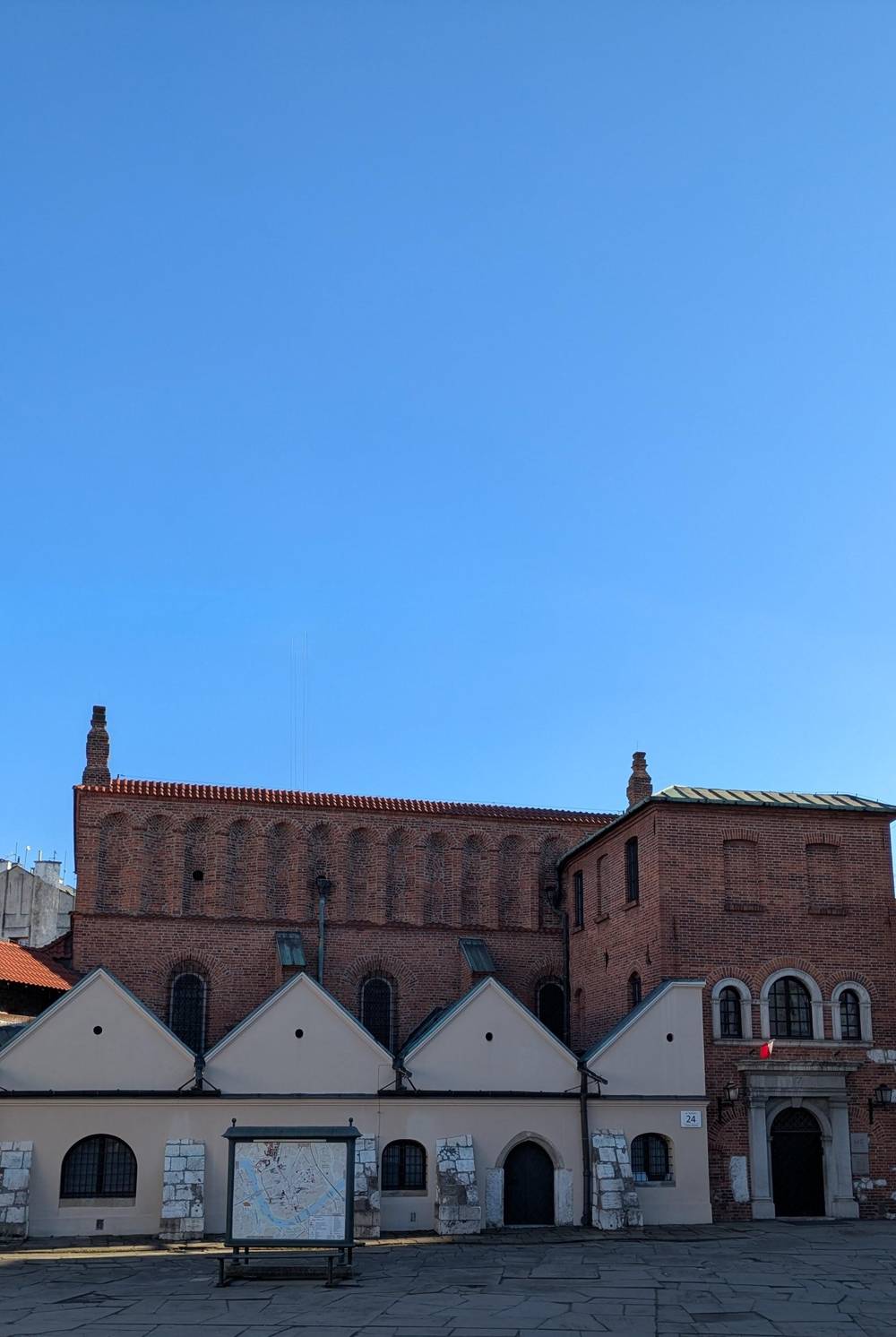
If you want context first, the Old Synagogue museum a few steps away presents the Jewish holidays and family life in its exhibition halls.43 Then cross to the Remuh, walk the cemetery, and finish at the Wall of Tears. The Miodowa cemetery is a separate trip: walk east along Miodowa Street past the Tempel, or take a tram to the ul. Miodowa stop.31 Give it a separate hour rather than squeezing it in at the end of a long day.
Any Kazimierz Jewish cemetery in Krakow is holy ground, and a few habits show respect. Men should cover their heads, as in the synagogues, where a head covering can be rented.32 Dress modestly, keep your voice low and do not eat, drink or smoke among the graves. Walk on the paths, never on the graves themselves, and do not sit on the stones. Children are welcome, but keep them close and explain beforehand where they are going.
Respect the calendar. Both cemeteries stay shut on the Sabbath and on Jewish holidays; on Fridays the community's sites close early as Shabbat begins.8,30 If you are unsure whether something is allowed, ask at the gate before you go in. Photograph the stones if you wish, but not people at prayer, and never pose for selfies at graves. If a guard or a member of the community asks you to stop something, do so without argument.
If a grave or a name moves you, the custom of leaving something behind is better honoured by quiet than by objects. The kvitelach at the Remuh's grave belong to the people who wrote them.26 Many visitors combine the cemetery with a guided walk of the district. The guided walk this site recommends names the Jewish cemetery among its places; its listing gives no entry tickets, so plan any time inside on your own.
FAQ
You enter through the Remuh Synagogue gate on Szeroka Street.10
Fragments that could not be restored were set into the wall along Szeroka.4
Visitors leave them hoping the rabbi will intercede for them.26
It is the only operating Jewish cemetery in Krakow.6
Among them are Maurycy Gottlieb, Ozjasz Thon and Leopold Kozłowski.22
Sources
Also worth reading
Planning a walk through Kazimierz? Ask a real person here.